Showing posts with label rock. Show all posts
Showing posts with label rock. Show all posts
Friday, June 24, 2011


Monday, June 20, 2011

Wednesday, October 20, 2010
Interview W/ Dr. Dog's Scott McMicken
"Dr. Dog @ The Blind Pig"
Dr. Dog singer/songwriter/guitarist Scott McMicken recently sat down to chat with MT Music Blog for this week's MC5 . McMicken, aside from a few of his favorite things in Detroit, talked about the band's always-growing catalog, their ties to psychedelic music and the creation of their own alphabet. The Philly quintet released their sixth studio album Shame, Shame earlier this year and also knocked out a few tracks for this upcoming tour where they head to Pontiac's Crofoot Ballroom tonight with Here We Go Magic & Prussia. Check it below for the full interview.
MT: I know you guys have opened up for The Raconteurs, and played at The Magic Stick in the past along with a few other venues around Detroit and Ann Arbor. What are some of your favorite things that you associate with coming to Detroit to play a show? What do you like about coming back to Detroit each time?
McMicken: Is Pontiac considered Detroit?
MT: It’d be considered the greater Metro Detroit area. About 20-30 minutes away from downtown.
McMicken: Ahhh gotcha. Well I always like, I dunno have a certain image of Detroit I guess. I like The Magic Stick a lot, I like when we play there we get to go bowling and stuff. My own memories are playing there with Bobby Bare Jr. and Jeffrey Lewis. I like to think about The High Strung [former Park The Van label mates] because they’re from Detroit. Always gets me thinking about lots of Motown music and all that Detroit garage-y rock, The Gories and all that kind of stuff.
I like the feel of Detroit’s history and I like that it seems to somehow, from what I understand about the music, to work with the present state of the city. There’s a sense of urgency behind everything there, I like that a lot. I have a lot family there, so that’s always cool. I used to love the Detroit Tigers a lot when I was a kid. I liked how when we first started going [to Detroit] we were real afraid, because people were telling us that people in Detroit are real hecklers and aggressive, but I like how every time we go it’s not really the case.
MT: We aren’t too bad. Are there any other Detroit musicians that you have been digging lately?
McMicken: I like Jack White a lot. I don’t really listen to much of his music, but I think he’s pretty awesome, he always seems to keep working real hard all the time. Nolan Strong and The Diablos. They are actually the thing I’ve been listening to the most. They kind of slipped through the cracks and just sort of resurfaced as this real gem for me. They’re one of the best things I’ve heard in a long time, I could easily put them at the top of my list of Detroit music. I like Iggy Pop a lot. There’s a lot of stuff I don’t know about, I’m always psyched to find out more about Detroit. I mean of course, the whole phenomenon of Motown music.
MT: did you guys blow out a tire last time leaving Pontiac?
McMicken: We did have a blow out there, and actually I ended up going to the hospital that day too! I went to the emergency room. I had a real weird show because I couldn’t hear anything, I had to have everybody else turn my amp on and adjust the sound and stuff because I had no perspective on sound of things. We were with The Growlers, they were so good.
"McMicken In Pontiac"
MT: Yea, they actually were just here at a loft in Mexicantown for another cool little show a few weeks back. Why don’t we talk about your the last two albums you guys have put out. In 2008 there was Fate, and this last year was Shame, Shame your debut on Anti-.
McMicken: Fate seems to have this weird phenomenon around it for a lot of folks, and for sure for own experience. It kind of took on this slightly larger than life air about it, as soon as we started throwing ideas about it. It was wow. Even in our experience making it, the sheer amount of impact it was having on us, and the things we were reacting to seemed as much out of our control as in of our control. There were a lot of things, I don’t mean this in any kind of pious way or anything, it was one of those points in time where things were aligned well enough to be able to be expressed almost without trying. Where we were at, what the songs were about, how we were recording and of course what we were interested in that very particular moment. So to react to particular things and draw them out that will always be a fond document of a period of time for us as well, so it’s cool that it translates to our listeners.
MT: I personally saw a few people fall in love with Dr. Dog on that album served as their introduction to you guys.
McMicken: I’ve felt like that was probably the best like… that album definitely got us going a lot more. Maybe our other albums before that, some people liked them and stuff, but maybe they were a little too inaccessible for some types of listeners. I feel like Fate just kind of came into focus a little more. We’re always learning about the recording process as we record ourselves. Each album we learn how to present things more clearly and concisely. I still really like all the old albums. Probably for a lot of people who don’t really listen to a lot of weirder music or anything, not that it’s the weirdest shit around or anything…but it’s got sort of an air of homespun or a lo-fi take on how to get stuff done. A lot of people probably aren’t maybe used to that, the weird sounds on the voices, the lack of guitars, things like that.
MT: So Fate, like all the albums before it, was mixed and engineered entirely by you guys and on Shame, Shame it was the first time you worked with an engineer and producer?
McMicken: Yea we wanted to try that whole way of doing things finally. We felt like we were ready to try it because we felt like we were getting better as a live band. So we thought we could put the songs together as a live band and then just try to find some real skilled engineers and producers to help us record them in a more live fashion. For all the experience we have making our own records and stuff we don’t really know anything about how to mic up a whole band and get it sounding good live in the studio. It was time to try that. It didn’t work out ideally. In the end, we ended up spending a month doing that…in theory we were supposed to be done in that month, but we were nowhere near done when it came to the end of the month. We spent two more months on our own back at our studio with the tapes trying to do them the way we normally do them. It’s kind of a combination of working with a producer and an engineer for the first time and then having a good solid two months with the tapes all on our own to do our thing. It worked out pretty good as far as just stepping outside of the boundaries of how we typically work for long enough to get some cool basic tracks and also get some new insight on a different way of recording and then kind of go back home and apply that to own type of way of doing things. It was good. It was kind of one foot in the door. It wasn’t a full on success in that way of working. But definitely one step in the right direction, and that’s something that we’ve continued to experiment with and will continue to do into the next record.
Dr. Dog In Pontiac [/caption]
MT: So are you looking for another producer/engineer set or back to recording on your own?
McMicken: The plan as it stands is to do it on our own, but not in our own studio. What we realized is that we don’t really need a producer, we just need a really good engineer. We’ve been producing records on our own for so long that there’s no shortage of ideas and no shortage of confidence at this point of how to arrange a tune and put it together. But we just need somebody who’s a better engineer so we can experiment with better/more subtle/richer tones, that’s where our shortcomings are still really prevalent. The next record is where we just recorded 4 songs this summer that were done in a studio in Philly called Minor Street (spelling). It’s run by an old friend of ours and we went in there to try it out and it worked out great. They have great engineers and we were able to be a live band but also experiment with things. It’s a perfect marriage of the old Dr. Dog and the new Dr. Dog. It felt really good, it felt like we could exercise our chops as live musicians with the feel and the groove but also feel free to rip it all apart and experiment with it, just be a lot more playful. Not just 5 guys clicking off and go and there’s your song. We were able to then sort of take it apart or manipulate it a lot which is something we’ve always enjoyed. It was all happening so fast thanks to these really great engineers, so it was kind of perfect. The plan is just to do it there the same way we did these four tunes this summer. There are also so many options, there are definitely still producers we’re still talking to.


MT: You were talking about psychedelic music before, I had read an interview where you had mentioned an accompanying album to go with your first album, The Psychedelic Swamp, which now out of print, is that still in the works?
McMicken: It’s in the works as far as; we’re definitely going to do it. It’s just a matter of time. It wouldn’t be very hard to find the time to do it. It wouldn’t be very hard because what’s required of us to complete it is conceptually built in to be very simple and kind of live rock and roll without any bells and whistles or tricks, without any psychedelia really, that’s the idea. The accompanying record to The Psychedelic Swamp would be a very very straightforward and direct, not psychedelic, translation of the whole garbled psychedelic record into just garage rock basically, that’s sort of the reason of what the whole about is about. It’s kind of a long story behind that record, but in a nutshell the idea behind it is that we didn’t make it. Dr. Dog didn’t make The Psychedelic Swamp. It was sent to us by a character named Phrases, who used to live on Earth, but escaped Earth and escaped all his woes to go to the psychedelic swamp as a means of release from all the troubles he was having in life. Then he gets there and at first he’s really excited and wowed and amazed at the lack of logic and lack of order to the universe. But he shortly thereafter realizes that the same issues and same problems persist. That his choice to just escape reality was not by any means a solution. He starts to get desperate and realizes this mistake he’s made but at the same time he’s spending all this time there and losing perspective on how to communicate with his former self and the former world that he was apart of. So the record becomes increasingly more and more incoherent. But he has this strong message that he really wants to spread to people so he chooses Dr. Dog to be the band to take this album that he’s made, it’s not even like an album, it’s kind of like a document of his experience in the swamp.
MT: At points it feels like a radio show, there’s a DJ leading you through these places.
McMicken: Exactly, it’s kind of this multimedia experience you’re hearing of the psychedelic swampland. You’re hearing what it’s like to listen to the radio there. You’re hearing advertisements. You’re hearing sort of the ambience of him being at work. You’re hearing the news. Yea. A lot of it is interspersed with sort of narrative songs. So he chooses Dr. Dog to translate this mess into an American pop context, so that his message could be heard and understood. So now we just have to do the thing of taking all the songs that are on there and like I said playing them very straightforward and recording them very simply so that they’re not manipulated at all, just straight to the point. When we do that prophecy will be fulfilled, and our job will have been done and we can release it. It seems silly for us to release it before we can do that because it’s a part of the whole concept. Also there are kind of pipe dreams about a movie. If we could ever one day turn it into a movie, that would be so great. Aside from the logistical nightmare of making a movie, it’d be pretty easy. The narrative is all there. In our heads it’s so fleshed out from point A to point B. It’s so visual in how involved we were getting into it at the time, talking about it and watching the story unfold before our very eyes on the 4-track. It’s all kind of there. It would just be a matter of getting involved with people who know about making movies and could help translate it. It’s still a work in progress. It’s something that we definitely still intend to get done one day it just becomes a question of when.
MT: Keeping with the psychedelic weirdness, it seems the first reference points that come to mind when people are talking about Dr. Dog are a the classic rock psychedelic pop three B’s, (The Beatles, The Beach Boys and The Band) what are there other artists that influence Dr. Dog that people might not hear right away?
McMicken: There’s so many. It’s interesting I often find myself coming back to this same problem. Obviously I know linguistically what you attach the term psychedelic to, but really in my experience listening to music, you take something like early Pink Floyd or something that is obviously psychedelic music. You listen to it, and you feel a certain way, and you get that kind of joy of that expansive color palette and that strange imaginary and surreal sonic landscape to transport you to some other place while you’re listening. I can get that same sensation listening things that you wouldn’t as easily call psychedelic music. I guess what I’m trying to say the term is really amorphous to me. It’s less a description of a type of sound, or a trend in a particular type of sound and more a type of perspective adopted when listening to music. It can be John Coltrane, it can be Louis Armstrong, it can be James Taylor for Christ sake! If your mind is open and willing to react to the sounds in a proactive way Joan Baez is psychedelic or Dylan. You look at Dylan and his words take you off in places like that. The sounds are so rooted, but the words are so loss-y. So psychedelic as a term for me often has more to do with how I’m listening than what I’m listening to. All that crap being said, there’s so much stuff that has an influence on the band that I guess you could call more psychedelic like R. Stevie Moore, Ariel Pink or even Tom Waits is psychedelic in his own way. He uses this palette of real grounded earthy-ness and raw emotive primitive type of feel, but it’s just as blown out of proportion as Dark Side of The Moon, it’s just as unrealistic. Tom Waits is real great music for your imagination. I always listen to Os Mutantes and feel like they are super psychedelic. Jimi Hendrix being a more classic example. Punk rock is a big influence on the band. The Clash is a big influence, I don’t know if that’s very apparent very often. Some of that kind of the new wave stuff like Television and The Talking Heads come up a lot in my understanding of subtle aspects of our tunes. Hip-hop has a lot to do with what we’ve been doing lately. I don’t know, the band has always been pretty wide open with what influences members want to bring to it. We don’t have a particular direction or course that we have to stay. I’ve been listening to a lot of Wu-Tang and Dr. Dre and there’s such cool atmosphere and tone and the rhythm to the phrasing. This is where all the sudden Wu-Tang has a lot in common with Bob Dylan, just rhythmic phrasing in a vocal performance whether it be a folk song or a modern hip-hop song is super compelling. Really just the application of rhythm to everything, rhythm in the drums, rhythm in the guitar playing. That’s where you can listen to African pop music and get so excited by the full on headstrong devotion to rhythmic feel in every instrument that’s being played and no longer is there just a guitar bashing away to fill space and make it feel large. You can achieve largeness through much smaller level expressions of very refined ideas in rhythm. The biggest thing lately for us has been the pursuit of off rhythms. So that applies to so much stuff, African pop music, oldies music in such a subtle way. If you pick up your instruments and try to play “Goin’ to the Chapel” or something, if you don’t know what you’re doing, even though it’s so simple, you’ll just sound like some white boy ska band or something. It’s all about the looseness and the feel of the ability to be cohesive with one another to make it feel that natural. It turns out that’s so hard. The simplest things are so hard sometimes.
MT: Is there anything else you’ve got planned with this upcoming tour?
McMicken: We’ve got a new double 7” that’ll be at our show. There are four new tunes with a whole new language that we’ve made up. We invented a new alphabet and the whole record is written in the new alphabet that you have to decode and figure out. It’s pretty sweet lookin’. It’s something.
MT: You guys always have some unique hard physical copies of your records.
McMicken: For us that part of the process is always so fun. Coming up with fun ideas and stuff, wherever there’s an outlet of doing some kind of fun idea and playing around with it we always can’t help ourselves.
Oct. 20th 8p.m. Dr. Dog wsg Prussia & Here We Go Magic, The Crofoot Ballroom, Pontiac,
This is the first installment in our multi-part exploration of The New Psychedelic. Look for more from Umphrey’s McGee and their new school of improvisation and Roger Waters’ re-imagining of The Wall.

Dr. Dog singer/songwriter/guitarist Scott McMicken recently sat down to chat with MT Music Blog for this week's MC5 . McMicken, aside from a few of his favorite things in Detroit, talked about the band's always-growing catalog, their ties to psychedelic music and the creation of their own alphabet. The Philly quintet released their sixth studio album Shame, Shame earlier this year and also knocked out a few tracks for this upcoming tour where they head to Pontiac's Crofoot Ballroom tonight with Here We Go Magic & Prussia. Check it below for the full interview.
MT: I know you guys have opened up for The Raconteurs, and played at The Magic Stick in the past along with a few other venues around Detroit and Ann Arbor. What are some of your favorite things that you associate with coming to Detroit to play a show? What do you like about coming back to Detroit each time?
McMicken: Is Pontiac considered Detroit?
MT: It’d be considered the greater Metro Detroit area. About 20-30 minutes away from downtown.
McMicken: Ahhh gotcha. Well I always like, I dunno have a certain image of Detroit I guess. I like The Magic Stick a lot, I like when we play there we get to go bowling and stuff. My own memories are playing there with Bobby Bare Jr. and Jeffrey Lewis. I like to think about The High Strung [former Park The Van label mates] because they’re from Detroit. Always gets me thinking about lots of Motown music and all that Detroit garage-y rock, The Gories and all that kind of stuff.
I like the feel of Detroit’s history and I like that it seems to somehow, from what I understand about the music, to work with the present state of the city. There’s a sense of urgency behind everything there, I like that a lot. I have a lot family there, so that’s always cool. I used to love the Detroit Tigers a lot when I was a kid. I liked how when we first started going [to Detroit] we were real afraid, because people were telling us that people in Detroit are real hecklers and aggressive, but I like how every time we go it’s not really the case.
MT: We aren’t too bad. Are there any other Detroit musicians that you have been digging lately?
McMicken: I like Jack White a lot. I don’t really listen to much of his music, but I think he’s pretty awesome, he always seems to keep working real hard all the time. Nolan Strong and The Diablos. They are actually the thing I’ve been listening to the most. They kind of slipped through the cracks and just sort of resurfaced as this real gem for me. They’re one of the best things I’ve heard in a long time, I could easily put them at the top of my list of Detroit music. I like Iggy Pop a lot. There’s a lot of stuff I don’t know about, I’m always psyched to find out more about Detroit. I mean of course, the whole phenomenon of Motown music.
MT: did you guys blow out a tire last time leaving Pontiac?
McMicken: We did have a blow out there, and actually I ended up going to the hospital that day too! I went to the emergency room. I had a real weird show because I couldn’t hear anything, I had to have everybody else turn my amp on and adjust the sound and stuff because I had no perspective on sound of things. We were with The Growlers, they were so good.
"McMicken In Pontiac"
MT: Yea, they actually were just here at a loft in Mexicantown for another cool little show a few weeks back. Why don’t we talk about your the last two albums you guys have put out. In 2008 there was Fate, and this last year was Shame, Shame your debut on Anti-.
McMicken: Fate seems to have this weird phenomenon around it for a lot of folks, and for sure for own experience. It kind of took on this slightly larger than life air about it, as soon as we started throwing ideas about it. It was wow. Even in our experience making it, the sheer amount of impact it was having on us, and the things we were reacting to seemed as much out of our control as in of our control. There were a lot of things, I don’t mean this in any kind of pious way or anything, it was one of those points in time where things were aligned well enough to be able to be expressed almost without trying. Where we were at, what the songs were about, how we were recording and of course what we were interested in that very particular moment. So to react to particular things and draw them out that will always be a fond document of a period of time for us as well, so it’s cool that it translates to our listeners.
MT: I personally saw a few people fall in love with Dr. Dog on that album served as their introduction to you guys.
McMicken: I’ve felt like that was probably the best like… that album definitely got us going a lot more. Maybe our other albums before that, some people liked them and stuff, but maybe they were a little too inaccessible for some types of listeners. I feel like Fate just kind of came into focus a little more. We’re always learning about the recording process as we record ourselves. Each album we learn how to present things more clearly and concisely. I still really like all the old albums. Probably for a lot of people who don’t really listen to a lot of weirder music or anything, not that it’s the weirdest shit around or anything…but it’s got sort of an air of homespun or a lo-fi take on how to get stuff done. A lot of people probably aren’t maybe used to that, the weird sounds on the voices, the lack of guitars, things like that.
MT: So Fate, like all the albums before it, was mixed and engineered entirely by you guys and on Shame, Shame it was the first time you worked with an engineer and producer?
McMicken: Yea we wanted to try that whole way of doing things finally. We felt like we were ready to try it because we felt like we were getting better as a live band. So we thought we could put the songs together as a live band and then just try to find some real skilled engineers and producers to help us record them in a more live fashion. For all the experience we have making our own records and stuff we don’t really know anything about how to mic up a whole band and get it sounding good live in the studio. It was time to try that. It didn’t work out ideally. In the end, we ended up spending a month doing that…in theory we were supposed to be done in that month, but we were nowhere near done when it came to the end of the month. We spent two more months on our own back at our studio with the tapes trying to do them the way we normally do them. It’s kind of a combination of working with a producer and an engineer for the first time and then having a good solid two months with the tapes all on our own to do our thing. It worked out pretty good as far as just stepping outside of the boundaries of how we typically work for long enough to get some cool basic tracks and also get some new insight on a different way of recording and then kind of go back home and apply that to own type of way of doing things. It was good. It was kind of one foot in the door. It wasn’t a full on success in that way of working. But definitely one step in the right direction, and that’s something that we’ve continued to experiment with and will continue to do into the next record.
Dr. Dog In Pontiac
[/caption]MT: So are you looking for another producer/engineer set or back to recording on your own?
McMicken: The plan as it stands is to do it on our own, but not in our own studio. What we realized is that we don’t really need a producer, we just need a really good engineer. We’ve been producing records on our own for so long that there’s no shortage of ideas and no shortage of confidence at this point of how to arrange a tune and put it together. But we just need somebody who’s a better engineer so we can experiment with better/more subtle/richer tones, that’s where our shortcomings are still really prevalent. The next record is where we just recorded 4 songs this summer that were done in a studio in Philly called Minor Street (spelling). It’s run by an old friend of ours and we went in there to try it out and it worked out great. They have great engineers and we were able to be a live band but also experiment with things. It’s a perfect marriage of the old Dr. Dog and the new Dr. Dog. It felt really good, it felt like we could exercise our chops as live musicians with the feel and the groove but also feel free to rip it all apart and experiment with it, just be a lot more playful. Not just 5 guys clicking off and go and there’s your song. We were able to then sort of take it apart or manipulate it a lot which is something we’ve always enjoyed. It was all happening so fast thanks to these really great engineers, so it was kind of perfect. The plan is just to do it there the same way we did these four tunes this summer. There are also so many options, there are definitely still producers we’re still talking to.
MT: You were talking about psychedelic music before, I had read an interview where you had mentioned an accompanying album to go with your first album, The Psychedelic Swamp, which now out of print, is that still in the works?
McMicken: It’s in the works as far as; we’re definitely going to do it. It’s just a matter of time. It wouldn’t be very hard to find the time to do it. It wouldn’t be very hard because what’s required of us to complete it is conceptually built in to be very simple and kind of live rock and roll without any bells and whistles or tricks, without any psychedelia really, that’s the idea. The accompanying record to The Psychedelic Swamp would be a very very straightforward and direct, not psychedelic, translation of the whole garbled psychedelic record into just garage rock basically, that’s sort of the reason of what the whole about is about. It’s kind of a long story behind that record, but in a nutshell the idea behind it is that we didn’t make it. Dr. Dog didn’t make The Psychedelic Swamp. It was sent to us by a character named Phrases, who used to live on Earth, but escaped Earth and escaped all his woes to go to the psychedelic swamp as a means of release from all the troubles he was having in life. Then he gets there and at first he’s really excited and wowed and amazed at the lack of logic and lack of order to the universe. But he shortly thereafter realizes that the same issues and same problems persist. That his choice to just escape reality was not by any means a solution. He starts to get desperate and realizes this mistake he’s made but at the same time he’s spending all this time there and losing perspective on how to communicate with his former self and the former world that he was apart of. So the record becomes increasingly more and more incoherent. But he has this strong message that he really wants to spread to people so he chooses Dr. Dog to be the band to take this album that he’s made, it’s not even like an album, it’s kind of like a document of his experience in the swamp.
MT: At points it feels like a radio show, there’s a DJ leading you through these places.
McMicken: Exactly, it’s kind of this multimedia experience you’re hearing of the psychedelic swampland. You’re hearing what it’s like to listen to the radio there. You’re hearing advertisements. You’re hearing sort of the ambience of him being at work. You’re hearing the news. Yea. A lot of it is interspersed with sort of narrative songs. So he chooses Dr. Dog to translate this mess into an American pop context, so that his message could be heard and understood. So now we just have to do the thing of taking all the songs that are on there and like I said playing them very straightforward and recording them very simply so that they’re not manipulated at all, just straight to the point. When we do that prophecy will be fulfilled, and our job will have been done and we can release it. It seems silly for us to release it before we can do that because it’s a part of the whole concept. Also there are kind of pipe dreams about a movie. If we could ever one day turn it into a movie, that would be so great. Aside from the logistical nightmare of making a movie, it’d be pretty easy. The narrative is all there. In our heads it’s so fleshed out from point A to point B. It’s so visual in how involved we were getting into it at the time, talking about it and watching the story unfold before our very eyes on the 4-track. It’s all kind of there. It would just be a matter of getting involved with people who know about making movies and could help translate it. It’s still a work in progress. It’s something that we definitely still intend to get done one day it just becomes a question of when.
MT: Keeping with the psychedelic weirdness, it seems the first reference points that come to mind when people are talking about Dr. Dog are a the classic rock psychedelic pop three B’s, (The Beatles, The Beach Boys and The Band) what are there other artists that influence Dr. Dog that people might not hear right away?
McMicken: There’s so many. It’s interesting I often find myself coming back to this same problem. Obviously I know linguistically what you attach the term psychedelic to, but really in my experience listening to music, you take something like early Pink Floyd or something that is obviously psychedelic music. You listen to it, and you feel a certain way, and you get that kind of joy of that expansive color palette and that strange imaginary and surreal sonic landscape to transport you to some other place while you’re listening. I can get that same sensation listening things that you wouldn’t as easily call psychedelic music. I guess what I’m trying to say the term is really amorphous to me. It’s less a description of a type of sound, or a trend in a particular type of sound and more a type of perspective adopted when listening to music. It can be John Coltrane, it can be Louis Armstrong, it can be James Taylor for Christ sake! If your mind is open and willing to react to the sounds in a proactive way Joan Baez is psychedelic or Dylan. You look at Dylan and his words take you off in places like that. The sounds are so rooted, but the words are so loss-y. So psychedelic as a term for me often has more to do with how I’m listening than what I’m listening to. All that crap being said, there’s so much stuff that has an influence on the band that I guess you could call more psychedelic like R. Stevie Moore, Ariel Pink or even Tom Waits is psychedelic in his own way. He uses this palette of real grounded earthy-ness and raw emotive primitive type of feel, but it’s just as blown out of proportion as Dark Side of The Moon, it’s just as unrealistic. Tom Waits is real great music for your imagination. I always listen to Os Mutantes and feel like they are super psychedelic. Jimi Hendrix being a more classic example. Punk rock is a big influence on the band. The Clash is a big influence, I don’t know if that’s very apparent very often. Some of that kind of the new wave stuff like Television and The Talking Heads come up a lot in my understanding of subtle aspects of our tunes. Hip-hop has a lot to do with what we’ve been doing lately. I don’t know, the band has always been pretty wide open with what influences members want to bring to it. We don’t have a particular direction or course that we have to stay. I’ve been listening to a lot of Wu-Tang and Dr. Dre and there’s such cool atmosphere and tone and the rhythm to the phrasing. This is where all the sudden Wu-Tang has a lot in common with Bob Dylan, just rhythmic phrasing in a vocal performance whether it be a folk song or a modern hip-hop song is super compelling. Really just the application of rhythm to everything, rhythm in the drums, rhythm in the guitar playing. That’s where you can listen to African pop music and get so excited by the full on headstrong devotion to rhythmic feel in every instrument that’s being played and no longer is there just a guitar bashing away to fill space and make it feel large. You can achieve largeness through much smaller level expressions of very refined ideas in rhythm. The biggest thing lately for us has been the pursuit of off rhythms. So that applies to so much stuff, African pop music, oldies music in such a subtle way. If you pick up your instruments and try to play “Goin’ to the Chapel” or something, if you don’t know what you’re doing, even though it’s so simple, you’ll just sound like some white boy ska band or something. It’s all about the looseness and the feel of the ability to be cohesive with one another to make it feel that natural. It turns out that’s so hard. The simplest things are so hard sometimes.
MT: Is there anything else you’ve got planned with this upcoming tour?
McMicken: We’ve got a new double 7” that’ll be at our show. There are four new tunes with a whole new language that we’ve made up. We invented a new alphabet and the whole record is written in the new alphabet that you have to decode and figure out. It’s pretty sweet lookin’. It’s something.
MT: You guys always have some unique hard physical copies of your records.
McMicken: For us that part of the process is always so fun. Coming up with fun ideas and stuff, wherever there’s an outlet of doing some kind of fun idea and playing around with it we always can’t help ourselves.
Oct. 20th 8p.m. Dr. Dog wsg Prussia & Here We Go Magic, The Crofoot Ballroom, Pontiac,
This is the first installment in our multi-part exploration of The New Psychedelic. Look for more from Umphrey’s McGee and their new school of improvisation and Roger Waters’ re-imagining of The Wall.
Monday, April 5, 2010
Julian Casablancas at St. Andrew's Hall
To say that Julian Casablancas has had a conventional rock and roll road would be a bit of a stretch. With no number off hand, it’s probably fairly safe to say the total of models turned rock lead singers are few and far between. The Strokes lead singer came to Detroit’s St. Andrew’s Hall with his solo band on a humid Monday night and his the show would prove to be anything but ordinary, whether or not that is a good thing can be your decision.
Casablancas opened up his show in dark, aside from a sparse blue can aimed down around the back of the stage it would remain fairly dark throughout the roughly 45-minute set. Casablancas sauntered on stage drink in had as he wavered back and forth during the swirling noise of the six-piece band behind him before going into “Ludlow Street,” to open the show. Casablancas’ band featured a drummer and percussionist, two guitarists, and two keyboard players, both of whom occasionally played guitars as well. Casablancas who took only vocal duties ala The Strokes, but this still made for a wall of sound coming from the dark stage, which wasn’t always a good thing. Some of the nuances of the album were lost as the occasional trio of guitars wouldn’t always mesh with the pinpoint accuracy they had on the album. The short set, only 8 songs, was taken from Casablancas’ recently released Phazes for The Young, save a take on The Strokes “Hard to Explain” which had the crowd thrashing up and down, and a slow keyboard duo of the B-side “I’ll Try Anything Once.”
The set closed with “Left & Right In The Dark” which characterized the short set, guitars and synthesizers mashing over one and other, occasionally syncing up but mostly overpowering each other in a hot mess with some raspy effect laden from Casablancas before he walked off stage letting he band slam to the end of the song. For an encore the band returned for the slow crashes of “4 Chords of The Apocalypse,” which actually had to be restarted from the drum break, but what followed was a bizarre ending to a show. A cover Casablancas has done before of Saturday Night Live’s “I Wish It Was Christmas Today.” Before starting the odd tune, Casablancas seemed poise to explain it’s placement, that he had recorded it previously, but instead brushed his hair back joking, “I’m not going to do my schpiel, I’m just going to act like it’s no big deal to do a Christmas song.” He then ran off stage again and the house lights sent the crowd out just as quickly the front man had bolted off stage.
The show was short, bizarre and visually unentertaining because it was so dark, none of which really seemed to match the airy bounce of the synthesizers and harmonized guitars that were so heavy throughout the album versions of Phazes. Maybe some effort into a stage show, possibly more than one light may help. Casablancas voice was fairly good, when he wasn’t mumbling or stumbling around the stage, but the set barely got going before it was over. It was also a bit odd to leave the crowd with a goofball cover after playing under an hour of music, seems like a kush gig.
Casablancas could potentially capture the depressed dance floor saunter he goes for on the album, the feel of the 1980’s house party movie band, think Oingo Boingo with “It’s A Dead Man’s Party” crooning while Rodney Dangerfield straightens his longfellow in a hot tub. A load of synthesizers, an implied self-aura of holier than thou trendiness, coupled with a cold snarl and some sort of Indian tail dangley-down, Casablancas could have the potential to guide you through that bar fight scene with Robert Downey’s mohawk, but he needs to actually put on a live performance that is worth a shit before he attempts the Triple Lundy. Feels great to work that reference in there so fuck you if you don't like it. Maybe the latest revival of The Strokes will spark a fire under Casablancas with a slot at Lollapalooza.
Casablancas opened up his show in dark, aside from a sparse blue can aimed down around the back of the stage it would remain fairly dark throughout the roughly 45-minute set. Casablancas sauntered on stage drink in had as he wavered back and forth during the swirling noise of the six-piece band behind him before going into “Ludlow Street,” to open the show. Casablancas’ band featured a drummer and percussionist, two guitarists, and two keyboard players, both of whom occasionally played guitars as well. Casablancas who took only vocal duties ala The Strokes, but this still made for a wall of sound coming from the dark stage, which wasn’t always a good thing. Some of the nuances of the album were lost as the occasional trio of guitars wouldn’t always mesh with the pinpoint accuracy they had on the album. The short set, only 8 songs, was taken from Casablancas’ recently released Phazes for The Young, save a take on The Strokes “Hard to Explain” which had the crowd thrashing up and down, and a slow keyboard duo of the B-side “I’ll Try Anything Once.”
The set closed with “Left & Right In The Dark” which characterized the short set, guitars and synthesizers mashing over one and other, occasionally syncing up but mostly overpowering each other in a hot mess with some raspy effect laden from Casablancas before he walked off stage letting he band slam to the end of the song. For an encore the band returned for the slow crashes of “4 Chords of The Apocalypse,” which actually had to be restarted from the drum break, but what followed was a bizarre ending to a show. A cover Casablancas has done before of Saturday Night Live’s “I Wish It Was Christmas Today.” Before starting the odd tune, Casablancas seemed poise to explain it’s placement, that he had recorded it previously, but instead brushed his hair back joking, “I’m not going to do my schpiel, I’m just going to act like it’s no big deal to do a Christmas song.” He then ran off stage again and the house lights sent the crowd out just as quickly the front man had bolted off stage.
The show was short, bizarre and visually unentertaining because it was so dark, none of which really seemed to match the airy bounce of the synthesizers and harmonized guitars that were so heavy throughout the album versions of Phazes. Maybe some effort into a stage show, possibly more than one light may help. Casablancas voice was fairly good, when he wasn’t mumbling or stumbling around the stage, but the set barely got going before it was over. It was also a bit odd to leave the crowd with a goofball cover after playing under an hour of music, seems like a kush gig.
Casablancas could potentially capture the depressed dance floor saunter he goes for on the album, the feel of the 1980’s house party movie band, think Oingo Boingo with “It’s A Dead Man’s Party” crooning while Rodney Dangerfield straightens his longfellow in a hot tub. A load of synthesizers, an implied self-aura of holier than thou trendiness, coupled with a cold snarl and some sort of Indian tail dangley-down, Casablancas could have the potential to guide you through that bar fight scene with Robert Downey’s mohawk, but he needs to actually put on a live performance that is worth a shit before he attempts the Triple Lundy. Feels great to work that reference in there so fuck you if you don't like it. Maybe the latest revival of The Strokes will spark a fire under Casablancas with a slot at Lollapalooza.
Wednesday, February 3, 2010
Dr. Dog w/ The Growlers at The Crofoot Ballroom
With their 2008’s Fate in the rear view mirror and Shame, Shame still a few months away, Dr. Dog has been building an impressive catalogue of perfectly pop saavy rock and roll tunes. The five piece from Philadelphia straddled albums and endured the harsh Michigan winter in Pontiac’s Crofoot Ballroom.

Shortly after, Dr. Dog took the stage at the roughly 250 person bar with “The Old Days,” to pull the crowd in with the raucous uptempo version as the band slammed into the choruses. The depth and vibrance of the studio wasn’t gone, but sped up and replaced with a raw energy to jump start the crowd. String melodies and other nuances from the studio were filled live throughout the night by both the thrashing dual guitars of Scott McMicken and Frank McElroy, and the spacey keyboard work of Zach Miller. Mixing in almost all the tracks from 2008’s Fate, the band skillfully creates a different, but still sonically lush landscape of the complex album.
Harnessing their vocal depth and variety kept the crowd on their toes as bassist Toby Lehman’s screeching and wildly unrestrained screams provided the perfect compliment for McMicken’s more conventional softer singing. The band also harmonizes vocally, instrumentally and physically incredibly well live, as they jump, twist and bounce in unison to country tinged stomping tunes like “The Pretender.”


Wednesday, November 18, 2009
Phish Comes to Cobo Hall
“I want to tell you, Detroit, that you done set me up for a comeback,” former Detroit Mayor Kwame Kilpatrick said after he was forced to resign last year. Echoing the words of the infamous Detroit mayor, Phish returned for a comeback of their own in the Motor City for this year’s fall tour opener, however, delivering on the comeback would be a different story. Save a few bright spots, (Down With Disease>Free and 46 Days) the show sounded like the first show of a tour, a bit rusty and apprehensive.
 The quartet came out to a barrage of roses from someone hopeful for Ween’s Roses Are Free, that unfortunately didn’t come. Most of the first set was fairly straightforward as nothing really found a perfect fit. With the newer songs Stealing Time From The Faulty Plan and Kill Devil Falls, guitarist Trey Anastasio’s, for lack of a better word, Joy, was apparent as he played these new compositions just as noticeably eager as he was the past summer to push the crowd to enjoy them as much as he seems to.
It’s Ice made for an interesting highlight of the first set, but most of the opening stanza was filled with slower tunes such as Mist. Things got slightly more upbeat with Poor Heart and 46 Days would branch out a bit, with Trey pinging notes over a spacey pulsing background soundscape while lighting director Chris Kuroda covered the side walls of Cobo Hall during the ambient improv. Slowly, the space in 46 Days fizzled into silence before it got to any real interesting territory.

With the hit of drummer Jon Fishman’s hi-hat, David Bowie attempted to give the first set a closing shot in the arm. However, the four members of Phish never really got in sync as the ending of Bowie sounded frantic and disconnected and never reached full throttle to finish the first set.
The second set would open up with a few bright spots, namely Runaway Jim and the highlight of the evening - Down With Disease -> Free. Trey would drive the jam out of Disease jumping around the stage as, for the first time in the night, all four members clicked in and barreled forward as Kuroda pulsed lights around the legendary venue.
 Soon Trey started fluttering chops across his Languedoc to slowly sneak into Free. The rest of the second set, however, went back to slower tunes. Waste, Taste, Bug and Wading In The Velvet Sea found a lot of people sitting down as a quiet cloud of chatter hung over the crowd.
Mike’s Song > I Am Hydrogen > Weekapaug Groove brought most of the crowd back to their feet. McConnell crunched a dark dirty organ in Mike’s Song for a change of pace, while Trey searched across the fretboard with slamming chords before going back into the verse of Mike’s. After the tender Hydrogen and a short Weekapaug, the second set ended with a predictable and standard Cavern.
Overall the show never found much, if any, solid coherence between all four members to create anything spectacular, but a certain amount of that is expected for a tour opener. A relatively inattentive and somewhat undersold crowd also didn’t help matters any. Here’s hoping the rest of the tour will find the band taking more chances and pulling out more surprises than they did in Detroit.
Scroll down for pictures and setlist. click thumbnails to enlarge.
It’s Ice made for an interesting highlight of the first set, but most of the opening stanza was filled with slower tunes such as Mist. Things got slightly more upbeat with Poor Heart and 46 Days would branch out a bit, with Trey pinging notes over a spacey pulsing background soundscape while lighting director Chris Kuroda covered the side walls of Cobo Hall during the ambient improv. Slowly, the space in 46 Days fizzled into silence before it got to any real interesting territory.
With the hit of drummer Jon Fishman’s hi-hat, David Bowie attempted to give the first set a closing shot in the arm. However, the four members of Phish never really got in sync as the ending of Bowie sounded frantic and disconnected and never reached full throttle to finish the first set.
The second set would open up with a few bright spots, namely Runaway Jim and the highlight of the evening - Down With Disease -> Free. Trey would drive the jam out of Disease jumping around the stage as, for the first time in the night, all four members clicked in and barreled forward as Kuroda pulsed lights around the legendary venue.
Mike’s Song > I Am Hydrogen > Weekapaug Groove brought most of the crowd back to their feet. McConnell crunched a dark dirty organ in Mike’s Song for a change of pace, while Trey searched across the fretboard with slamming chords before going back into the verse of Mike’s. After the tender Hydrogen and a short Weekapaug, the second set ended with a predictable and standard Cavern.
Overall the show never found much, if any, solid coherence between all four members to create anything spectacular, but a certain amount of that is expected for a tour opener. A relatively inattentive and somewhat undersold crowd also didn’t help matters any. Here’s hoping the rest of the tour will find the band taking more chances and pulling out more surprises than they did in Detroit.
Scroll down for pictures and setlist. click thumbnails to enlarge.
Phish
November 18, 2009
Cobo Arena
Detroit, MI
Set 1: AC/DC Bag, Foam, Stealing Time From The Faulty Plan, Bouncing Around The Room, Sample In A Jar, Kill Devil Falls, It’s Ice, Horn. Mountains In The Mist, Poor Heart, 46 Days, David Bowie
Set 2: Runaway Jim, Down With Disease -> Free, Waste, Taste, Bug, Wading In The Velvet Sea, Mike’s Song > I Am Hydrogen > Weekapaug Groove, Cavern
Encore: Character Zero


by Pietro C. Truba
originally for Glidemagazine.com
Wednesday, November 11, 2009
The Fiery Furnaces at The Magic Bag
After The Fiery Furnaces left the stage on Veteran’s Day, I couldn’t help but think that their live show wasn’t what I had imagined going in, only slightly familiar with their catalog. With their latest studio work that featured a rollicking keyboard laden, post modern soundscape to allow singer Eleanor Friedberger to be the group’s centerpiece, I assumed there be someone behind the ivories at some point. However, as The Fiery Furnaces took the stage at The Magic Bag on November 11th, their set up was noticeably stripped down. Not to say this is a bad thing.
The duo of siblings Matthew and Eleanor Friedberger, were joined by bassist Jason Lowenstein and drummer Bob D’Amico. Signature keyboard lines were taken by Matthew on guitar, who was armed with merely one effect pedal to add select noise to his vintage telecaster. Eleanor’s voice which laid so heavily over the layers of sound on the last record I’m Going Away, was occasionally lost in the energy of the power trio thrashing away behind her.
With a clear cut effort to replace the studio keyboard work with just guitar the choice made for some unique and different interpretations. The opening “Rub-Alcohol Blues” replaced the calming, smooth keyboard backing with prickly guitar pings from Matthew. On other songs Matthew’s guitar added some extra speed as he punched out riffs on songs like “Keep Me In The Dark,” which was given a shot of energy. The trio of instruments stripped the songs down to their bare bones, and on occasion it caused a few of them to blend together, sounding very similar. D’Amico and Lowenstein create a throttling rhythm section for Matthew to accent. The short set was complete with an encore featuring a few crowd requests as Eleanor sheepishly said, “We’ve got a lot of songs under our belt, so hopefully we can make someone happy…” as a fan screamed for “Japanese Slippers.”
Overall the show, despite being a hair over an hour including the encore, was above all entertaining. To see the two siblings rework their songs created some endearing and unique moments, while it proved that the group is set on mixing older and newer material into an amalgamation of the most basic sounds of the band that have endured through their entire catalog.
Click the thumbnails to enlarge.


Thursday, October 8, 2009
Them Crooked Vultures at The Fillmore Detroit
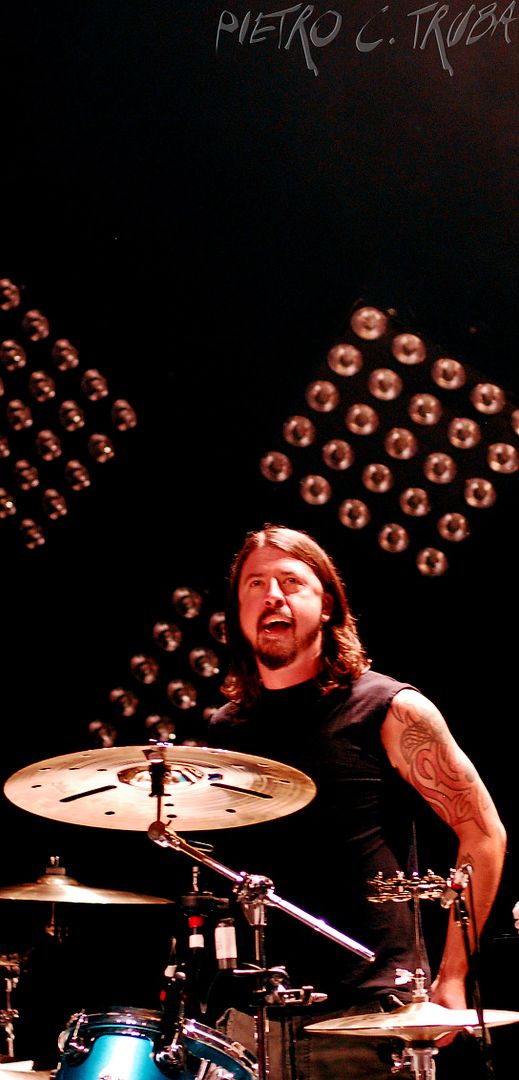
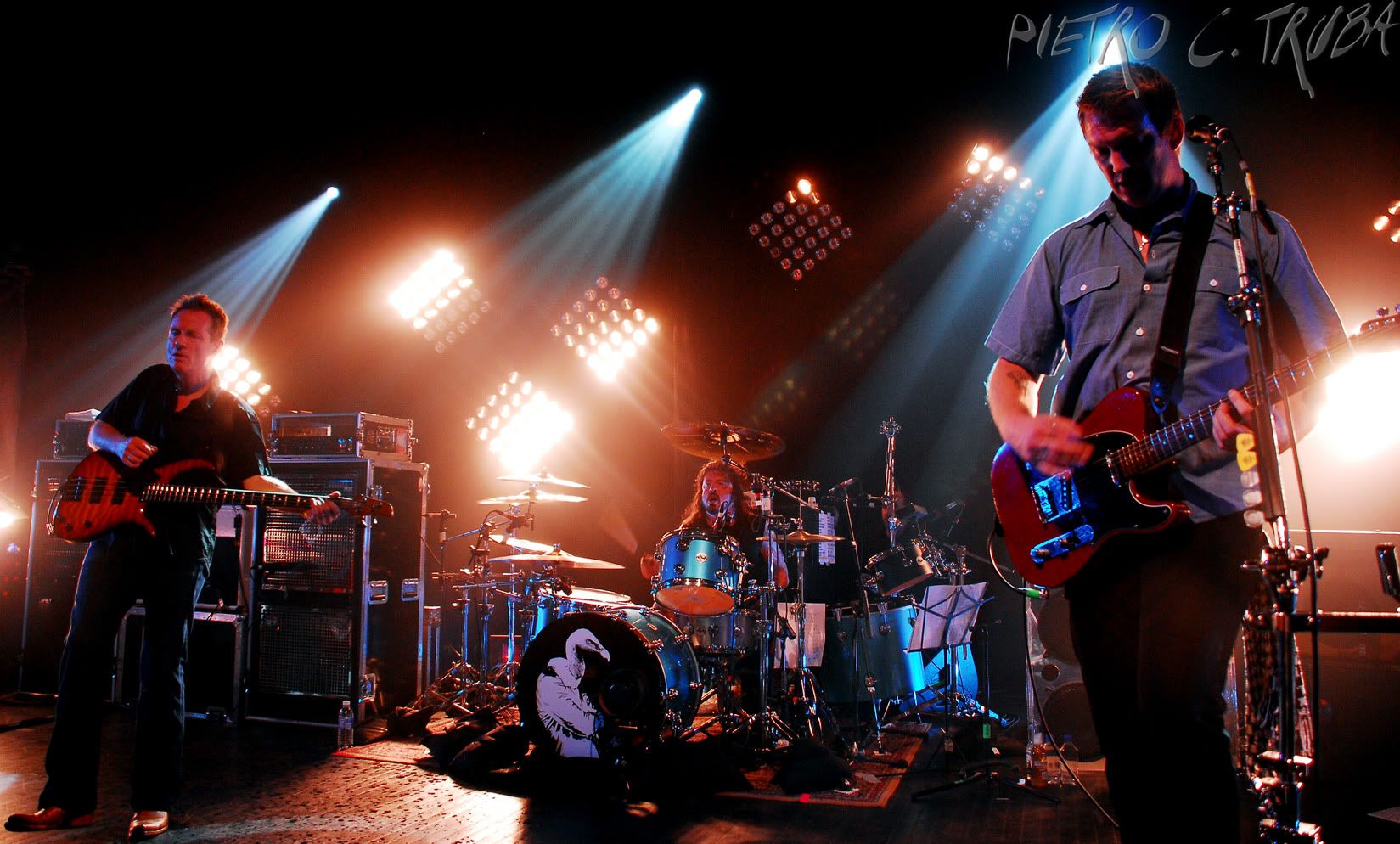
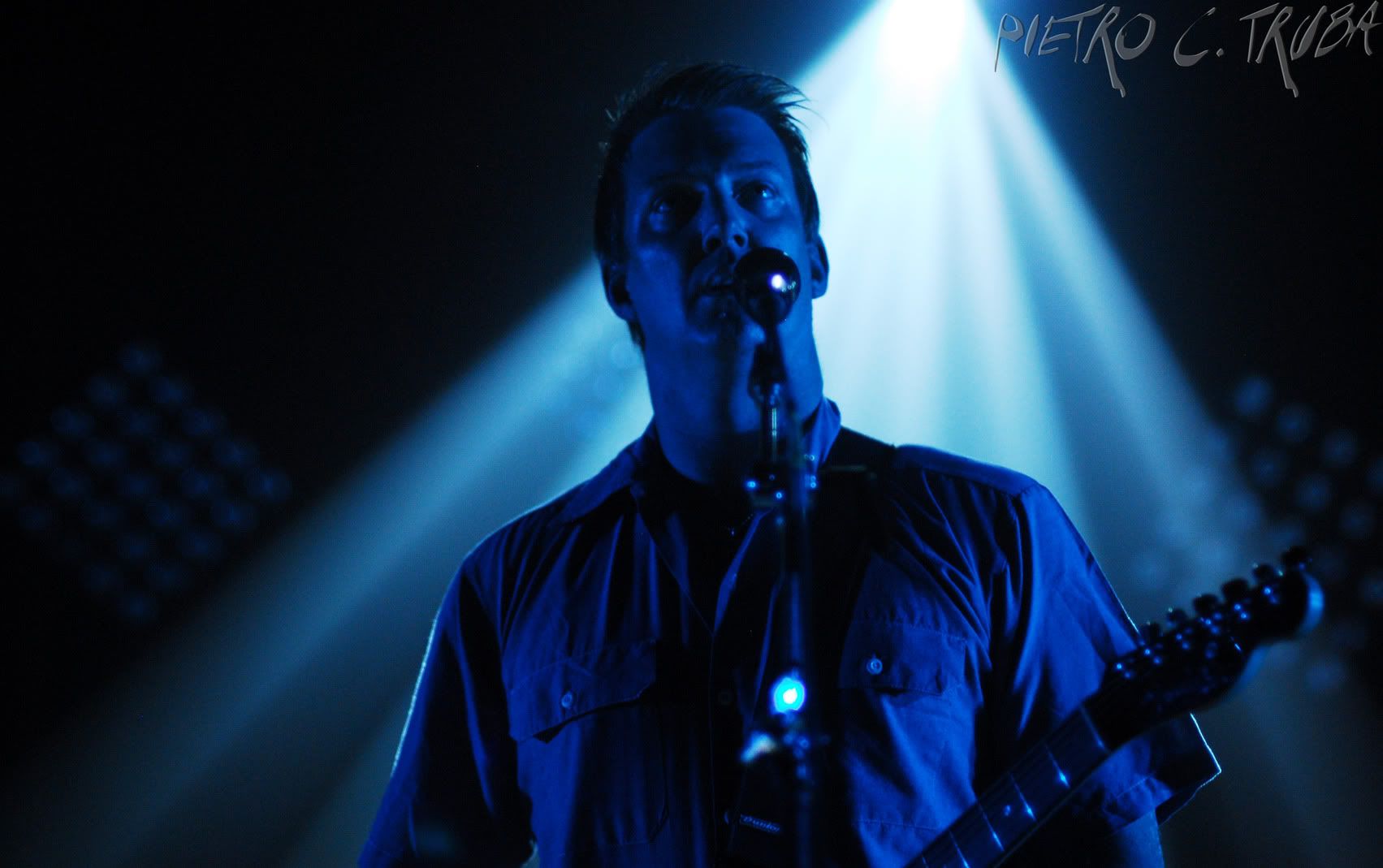
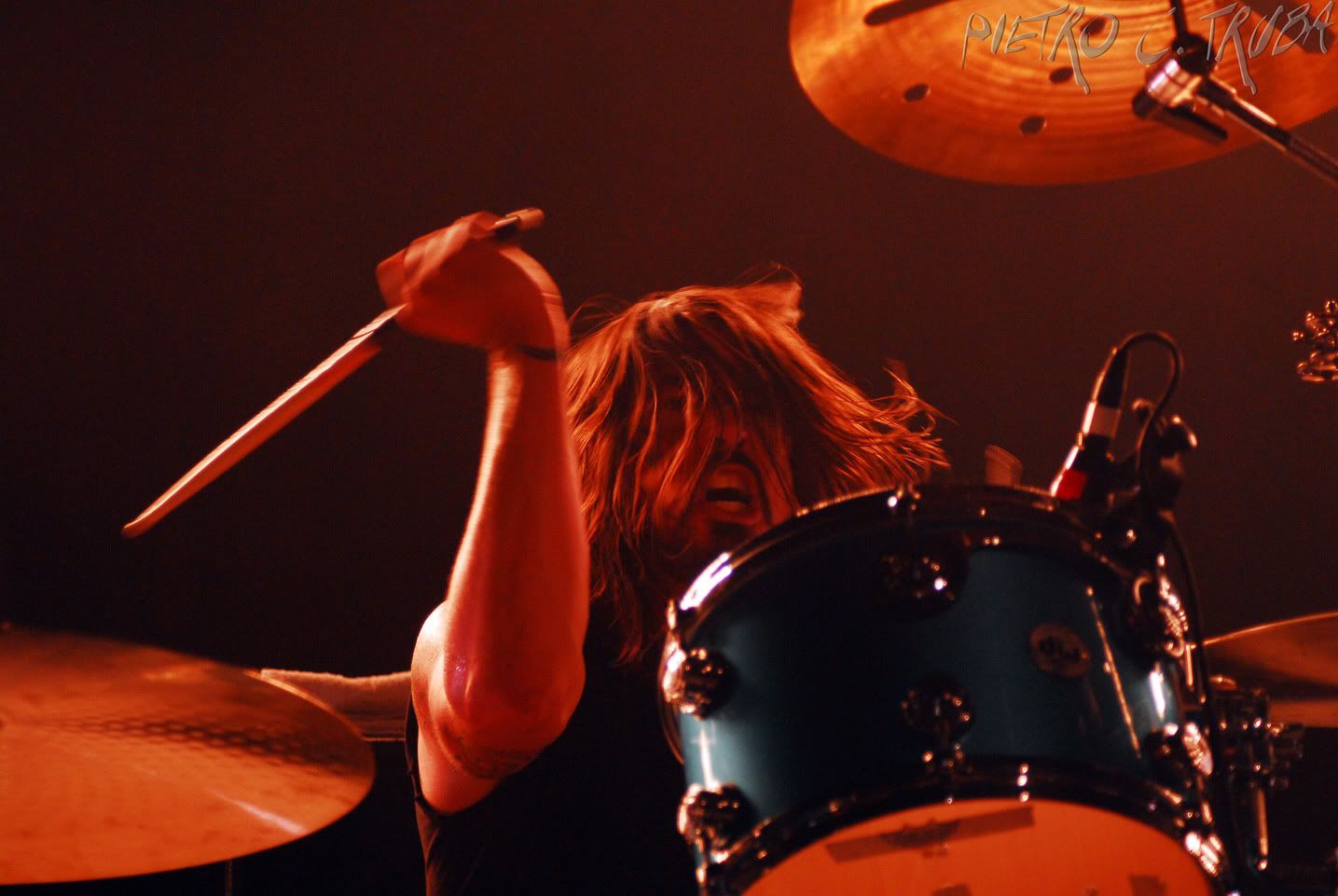
The profile of Them Crooked Vultures is cast fairly low right now, considering the personnel. The trio of John Paul Jones (Led Zeppelin) Dave Grohl (Foo Fighters/Nirvana) and Josh Homme (Queens of the Stone Age) relied on word of mouth and internet chatter to build a buzz for a tour and an album that isn’t even out yet. After some scattered shows across Europe the, shudder to say, supergroup, is now heading across the US and then back to Europe. All the while the group’s most official releases are a few thirty second youtube teasers.
What is apparent as Them Crooked Vultures took the stage at Detroit’s Fillmore is the joy on Grohl’s face as he sits behind the drum kit looking over to see John Paul Jones as the other half of his rhythm section. The two mesh up perfectly as Grohl smashes through his drums while peering occasionally to lock in with Jones’ nimble basslines. Homme, who carries the majority of the lead singing, is also joined on guitar by fellow QOTSA multi-instrumentalist Alain Johannes, for the group’s vintage tinged dual guitar attack. Homme, Jones and Johannes all took their share of slide guitar work as well.
Not surprisingly, it is Jones who pushes the band into some interesting territories. Most of the show is fairly straightforward hard rock, with Grohl leading the charge behind the drumkit. However there were a few curveballs with Grohl utilizing his e-drums and Jones on a keytar during the eerie crawl of “Interlude With Ludes.” Jones spent the show bouncing around from bass, keyboards and slide guitar. With the exception two slower tunes, it was the hard rocking tunes like the needling of “Scumbag Blues,” (which had Homme snap a string as he wailed away on his final solo,) and the extended closing “Warsaw,” that fueled the eighty minute set with no encore.
So, the always popular question for any supergroup, is the sum greater than the parts? When it comes to Them Crooked Vultures, the live feel of the band is, in the words of a front row fan, “to make you feel every fucking decibel.” While the live quartet feeds off each other well, Grohl is still ravenous behind the drumkit and Jones’ basslines and keyboard work create a lot of unique riffs for the Queens’ guitar work to build off. However, it seems as the studio will really be where the depth and the unique musical talent of the tunes this band has written will be able to shine the brightest.


by Pietro C. Truba
Originally for Relix Magazine
What is apparent as Them Crooked Vultures took the stage at Detroit’s Fillmore is the joy on Grohl’s face as he sits behind the drum kit looking over to see John Paul Jones as the other half of his rhythm section. The two mesh up perfectly as Grohl smashes through his drums while peering occasionally to lock in with Jones’ nimble basslines. Homme, who carries the majority of the lead singing, is also joined on guitar by fellow QOTSA multi-instrumentalist Alain Johannes, for the group’s vintage tinged dual guitar attack. Homme, Jones and Johannes all took their share of slide guitar work as well.
Not surprisingly, it is Jones who pushes the band into some interesting territories. Most of the show is fairly straightforward hard rock, with Grohl leading the charge behind the drumkit. However there were a few curveballs with Grohl utilizing his e-drums and Jones on a keytar during the eerie crawl of “Interlude With Ludes.” Jones spent the show bouncing around from bass, keyboards and slide guitar. With the exception two slower tunes, it was the hard rocking tunes like the needling of “Scumbag Blues,” (which had Homme snap a string as he wailed away on his final solo,) and the extended closing “Warsaw,” that fueled the eighty minute set with no encore.
So, the always popular question for any supergroup, is the sum greater than the parts? When it comes to Them Crooked Vultures, the live feel of the band is, in the words of a front row fan, “to make you feel every fucking decibel.” While the live quartet feeds off each other well, Grohl is still ravenous behind the drumkit and Jones’ basslines and keyboard work create a lot of unique riffs for the Queens’ guitar work to build off. However, it seems as the studio will really be where the depth and the unique musical talent of the tunes this band has written will be able to shine the brightest.

by Pietro C. Truba
Originally for Relix Magazine
Subscribe to:
Posts (Atom)